
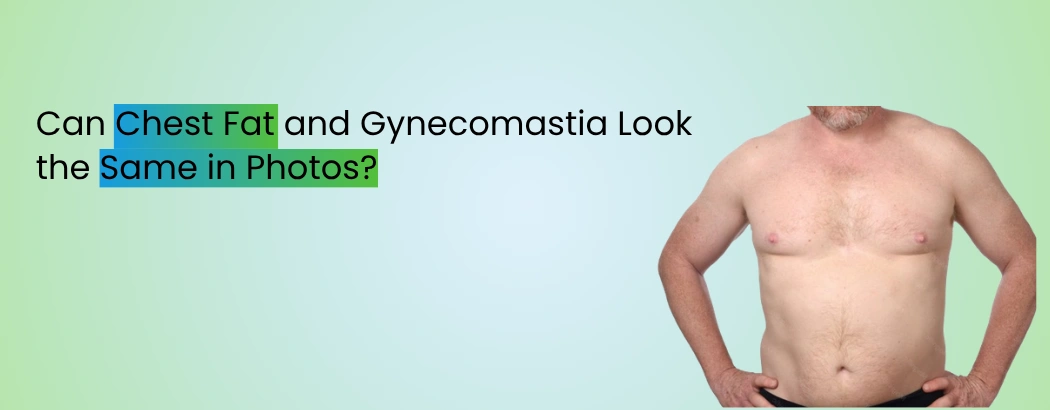
Can Chest Fat and Gynecomastia Look the Same in Photos?
Take a quick selfie in the gym mirror or scroll through an old beach photo, and you might suddenly notice something that makes you uncomfortable: your chest looks fuller than you expected. For many men, this leads to an immediate question: "Is this just chest fat, or do I have gynecomastia?"
The confusion is understandable because, in photographs, chest fat and gynecomastia can look remarkably similar. Lighting, posture, camera angles, body position, and even the fit of a T-shirt can make the chest appear larger or more prominent than it actually is.
The good news is that a photograph alone cannot diagnose gynecomastia. While images may raise suspicion, they rarely tell the full story. Understanding the difference between excess fat and enlarged breast tissue is essential before assuming the worst or deciding on treatment.
Why Photos Can Be Misleading
Modern smartphone cameras use wide-angle lenses that can distort body proportions, especially when pictures are taken from close distances. Shadows may exaggerate contours, while poor posture can make the chest project forward.
Other factors that influence how the chest appears in photos include:
-
Camera angle
-
Lighting conditions
-
Arm position
-
Body posture
-
Clothing fit
-
Recent weight gain or loss
As a result, many perfectly healthy men become concerned after seeing an unflattering picture, even though there is no underlying medical condition.
What Is Chest Fat?
Chest fat, sometimes called pseudogynecomastia, occurs when excess fatty tissue accumulates in the chest area.
It is commonly associated with:
-
Weight gain
-
Obesity
-
Reduced physical activity
-
General body fat distribution
In many cases, chest fat decreases with:
-
Healthy eating
-
Regular exercise
-
Overall weight loss
-
Strength training
The chest may feel soft to touch and usually blends with surrounding fatty tissue elsewhere on the body.
What Is Gynaecomastia?
Gynaecomastia is different.
Instead of excess fat alone, it involves enlargement of glandular breast tissue in males. This gland tissue develops due to hormonal influences and may be associated with:
-
Puberty
-
Hormonal imbalance
-
Certain medications
-
Steroid use
-
Liver or kidney disease
-
Genetics
-
Aging
Unlike simple fat accumulation, glandular tissue often feels firmer beneath the nipple and may remain even after significant weight loss.
Some men also experience:
-
Puffy nipples
-
Localized tenderness
-
A rubbery or firm lump beneath the areola
-
Chest asymmetry
Why They Look So Similar in Pictures
From the outside, both conditions may create a rounded chest contour.
In photos, it can be almost impossible to distinguish whether fullness comes from fat, gland tissue, or a combination of both.
For example:
-
A man with excess body fat may appear to have gynecomastia because the chest stores additional fat.
-
A lean man with true gynecomastia may have a well-defined body but still show noticeable puffiness around the nipples.
-
Someone with both fat and glandular tissue may have features of each condition.
This overlap is why photographs alone cannot provide a reliable diagnosis.
The Mirror Can Be Misleading Too
Interestingly, many men become more concerned after repeatedly checking themselves in mirrors.
Different mirrors, lighting conditions, and body positions can dramatically change appearance.
Standing relaxed, flexing the chest muscles, or raising the arms overhead may all create different visual impressions.
Rather than relying on repeated visual inspection, a proper physical examination provides much more useful information.
Can Weight Loss Solve the Problem?
If chest fullness is primarily caused by excess fat, losing weight often leads to noticeable improvement.
However, many men become frustrated after reaching their fitness goals only to find that the chest still appears enlarged.
This happens because glandular tissue does not respond to exercise in the same way fat does.
Some men achieve excellent muscle definition everywhere except around the nipples, where persistent fullness remains despite disciplined workouts.
Signs That May Suggest Gynecomastia
While diagnosis requires professional evaluation, certain features may raise suspicion:
-
Firm tissue directly beneath the nipple
-
Puffy or protruding areolas
-
Enlargement that persists after weight loss
-
Tenderness or sensitivity
-
Chest asymmetry
-
Minimal improvement despite regular exercise
These signs do not confirm gynecomastia, but they may indicate that further assessment is worthwhile.
Can You Diagnose Yourself Online?
The internet contains thousands of comparison photos and self-tests claiming to distinguish chest fat from gynecomastia.
Unfortunately, self-diagnosis is often unreliable.
Two men with nearly identical-looking chests may have completely different underlying causes.
Likewise, one person may incorrectly assume they have gynecomastia when the issue is simply fat distribution, while another may dismiss true gland enlargement as weight gain.
Clinical examination remains the most dependable way to identify the cause.
The Importance of a Medical Evaluation
When evaluating chest enlargement, healthcare professionals consider more than appearance alone.
They may assess:
-
Medical history
-
Medication use
-
Weight changes
-
Hormonal factors
-
Physical examination findings
-
Symmetry of the chest
-
Tissue consistency
In selected cases, imaging or laboratory investigations may also be recommended if an underlying medical condition is suspected.
Treatment Depends on the Cause
Because chest fat and gynecomastia are different conditions, treatment approaches differ as well.
If the problem is excess fat:
-
Lifestyle modification
-
Weight management
-
Exercise
-
Nutritional guidance
may provide significant improvement.
If true gynaecomastia is present:
Persistent glandular tissue may not disappear with dieting or exercise alone. In suitable candidates, surgical management can help remove the excess tissue and improve chest contour.
The best treatment plan depends entirely on the underlying diagnosis.
Emotional Impact Is Often Underestimated
Many men feel embarrassed discussing chest concerns.
Some avoid swimming pools, fitted clothing, changing rooms, or photographs altogether.
Others spend years trying increasingly intense workout routines without understanding why the chest remains unchanged.
Recognizing that chest enlargement is common and often treatable can help reduce unnecessary anxiety and encourage informed decision-making.
Frequently Asked Questions
Can a photograph confirm gynecomastia?
No. Photos may suggest chest fullness but cannot reliably distinguish between fat and glandular tissue.
Is gynecomastia always obvious?
Not necessarily. Mild cases may only present as subtle nipple puffiness or localized fullness.
Can skinny men have gynecomastia?
Yes. Even men with very low body fat can develop enlarged glandular breast tissue.
Does chest fat always disappear with exercise?
If caused primarily by excess fat, it often improves with weight loss. However, stubborn fat distribution and glandular tissue may persist.
Can someone have both chest fat and gynecomastia?
Yes. Many men have a combination of fatty tissue and enlarged glandular tissue, making diagnosis more challenging.
Final Thoughts
If your chest looks different in photos than you expect, try not to jump to conclusions.
Images can be deceptive, and chest fat and gynaecomastia often look nearly identical in pictures. Camera angles, posture, lighting, and body composition all influence appearance.
The key difference lies beneath the surface. While excess fat may improve with healthy lifestyle changes, true gynecomastia involves glandular tissue that often requires a different approach.
Rather than relying on selfies or online comparisons, seek an accurate evaluation if persistent chest fullness concerns you. Understanding the cause is the first step toward choosing the most appropriate path forward and regaining confidence in your appearance.
At Minnerva Clinic, patient education and individualised assessment are at the heart of every consultation because the right diagnosis always comes before the right treatment.