Can Loose Skin After Weight Loss Be Fixed Without Major Surgery?
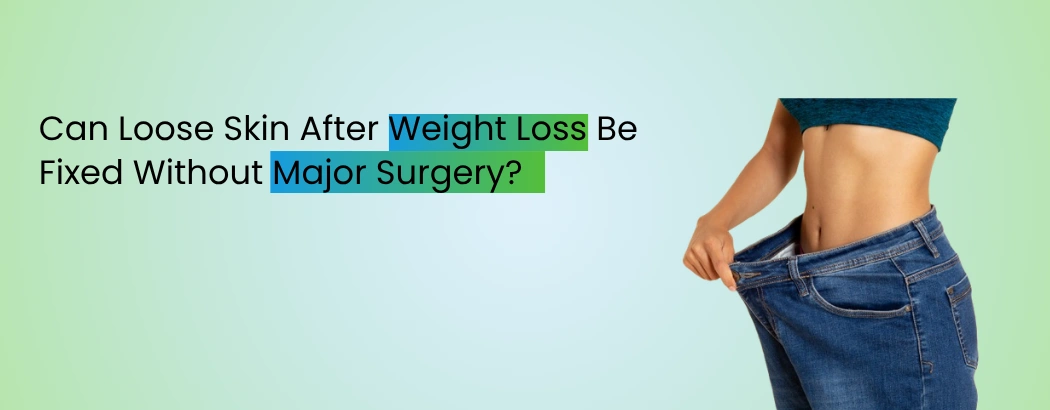
The journey to significant weight loss is often viewed as the final destination of a personal transformation. You have spent months, perhaps years, focused on the numbers on the scale, the fit of your clothes, and the metrics of your metabolic health. Yet, as you arrive at your goal weight, you are greeted by an unexpected consequence: the skin, which once expanded to accommodate your former self, does not always possess the elasticity to retract perfectly.
This realization—that your physical reflection still does not quite match the internal victory you have achieved—can be profoundly frustrating. It is common to feel that your skin is telling a story you have already outgrown. Many people immediately assume that the only remaining option is aggressive surgical excision, a path that involves significant downtime, scarring, and the inherent risks of major operations.
But does the path to a tighter, more contoured physique always lead to the operating table? The answer is shifting, thanks to advancements in non-invasive and minimally invasive clinical technologies.
The Elasticity Paradox: Why Skin Stays Behind
To understand why loose skin occurs, we must view the skin not as a mere covering, but as a complex, three-dimensional organ. It is composed of a dense matrix of collagen and elastin—the structural proteins that provide tension and snap-back.
When you lose weight rapidly, or after a long period of carrying excess weight, the collagen matrix undergoes a form of "stretching fatigue." Think of it like a rubber band that has been held at full tension for too long; even when the tension is released, the rubber band no longer returns to its original, tight shape. It has lost its elastic memory.
Furthermore, loose skin is often a combination of two distinct issues:
-
Dermal Laxity: The skin itself has lost its structural integrity.
-
Subcutaneous Persistence: There is often a residual layer of fat or fibrous tissue just beneath the skin that weighs it down, preventing it from adhering closely to the underlying musculature.
The "major surgery" approach focuses purely on the former, cutting away the excess. However, modern aesthetic medicine is increasingly focusing on the latter, stimulating the body to reorganize its own structural proteins to create natural, non-surgical tightening.
The Clinical Shift: From Excision to Regeneration
The era of "cut-and-pull" is being challenged by the era of "stimulate-and-contract." If we can encourage the skin to produce new collagen and encourage the deep tissues to become more cohesive, we can often achieve a meaningful aesthetic improvement without the trauma of a major procedure.
1. Energy-Based Tissue Tightening
One of the most effective non-surgical tools in our arsenal involves the use of precisely controlled energy—specifically, radiofrequency (RF) and ultrasound. These technologies deliver controlled heat into the deeper layers of the dermis and the sub-dermal connective tissue.
This thermal energy does two things:
-
Immediate Contraction: It causes existing collagen fibers to shorten and tighten immediately.
-
Long-Term Remodeling: By triggering the body’s "wound healing" response, it stimulates the production of brand-new, organized collagen. Over the months following treatment, the skin thickens, strengthens, and naturally tightens over the body’s contours.
2. The Role of Regenerative Medicine
Beyond external heat, we can now use the body’s own regenerative signals to enhance skin retraction. By utilizing advanced regenerative scalp and skin therapies, we can introduce growth factors into the dermal matrix. These signals act as a wake-up call to the skin cells, encouraging them to behave like "younger" cells, producing more elastin and collagen, which is critical for that sought-after snap-back effect.
3. Precision Fat Remodeling
Sometimes, skin appears loose simply because it is draped over stubborn, persistent pockets of fat. By using targeted, minimally invasive techniques to refine these fat deposits, we can reduce the volume beneath the skin, allowing it to "drape" better and appear tighter against the frame. It is not about weight loss—it is about refining the shape of the silhouette.
Clinical Design Tip: Addressing structural and aesthetic insecurities requires moving beyond the "masking" phase and into the "restoration" phase. Explore how clinical precision can rectify the false narratives of your physical appearance: Can Vitamin Deficiencies Cause Hair Loss Even If You Feel Healthy?
Why Home Remedies and Creams Fail
It is tempting to believe that a high-end firming cream or a rigorous massage routine will solve the issue of loose skin. The beauty industry spends billions marketing the idea that topical ingredients can "lift" the body.
However, we must be candid about the limitations: the skin is a formidable barrier designed to keep things out. Most molecules in topical firming creams are far too large to penetrate the epidermis and reach the deep dermal collagen matrix where true tightening occurs. They may hydrate the skin, making it look smoother temporarily, but they cannot reach the structural architecture of the skin to trigger a real, lasting change in elasticity.
If you are serious about fixing loose skin, you must work at the level where the structure is built—the dermis and the deep connective tissue.
The Personalized Path to Contouring
The "one-size-fits-all" approach is the reason many people feel surgery is their only option. In reality, the success of non-surgical tightening depends entirely on the quality of the skin you are starting with and the distribution of your remaining tissue.
A clinical assessment for skin tightening typically involves:
-
Elasticity Mapping: Determining how much "natural snap" your skin still possesses.
-
Distribution Analysis: Distinguishing between true skin laxity and residual adipose tissue.
-
Layered Protocol Design: Combining energy-based tightening with regenerative support to create a comprehensive plan that works with your body’s specific repair cycle.
This is not a quick fix. It is a biological process. Because we are asking your body to build new proteins and restructure its own tissue, this approach requires patience and a commitment to a multi-stage clinical plan. But for those who wish to avoid the scarring, anesthesia, and long recovery of traditional surgery, the result is often far more natural and harmonious.
Reclaiming Your Shape
You have worked incredibly hard to reach your current weight. Your body has been through an enormous change, and it deserves to be treated with care and precision, not just seen as something to be "cut."
If you find yourself feeling self-conscious about loose skin, do not settle for the binary choice of accept it as it is or undergo major surgery. There is a middle path—a clinical, science-backed approach to restoration that respects the integrity of your body while helping you achieve the aesthetic results you desire.
The story of your transformation doesn't have to end with a compromise. It can continue with a refinement, allowing you to finally look in the mirror and see the version of yourself you have been working so hard to create.
🔴 REQUEST A SPECIALIZED BODY CONTOURING ASSESSMENT
Are you ready to explore how clinical innovation can tighten, firm, and refine your physique without the need for invasive surgery? Our team at Minnerva Clinic is ready to help you map out a personalized restoration strategy.
-
Direct Hotline / WhatsApp: +91 7080213331
-
Our Premium Clinic Location: Minnerva Clinic, Lucknow, Uttar Pradesh
-
Contact Our Expert Team: Get in Touch Here