
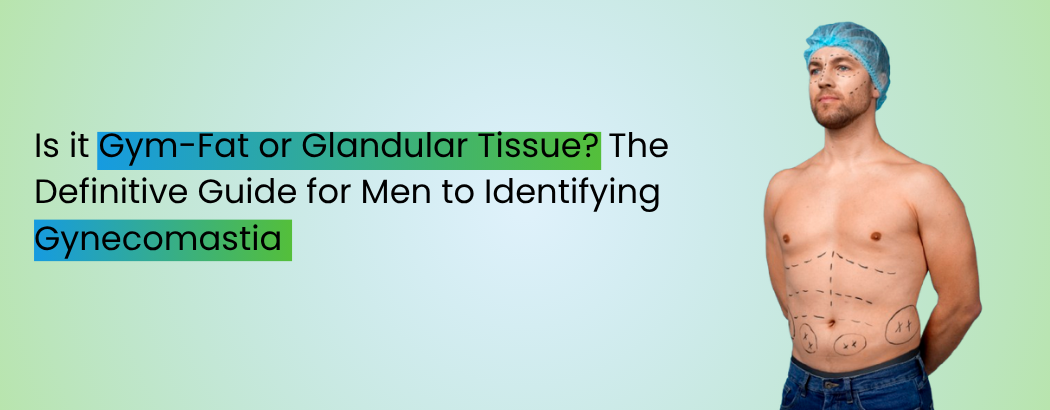
Is it Gym-Fat or Glandular Tissue? The Definitive Guide for Men to Identifying Gynecomastia
In the world of men's fitness, the "chest day" is sacred. For many, the goal is a flat, muscular, and well-defined pectoral region. However, there is a large demographic of men—from dedicated bodybuilders to casual gym-goers—who find that despite a clean diet and a heavy bench press, their chest remains "pointed," "soft," or "feminine" in appearance.
At Minnerva Clinic, Dr. Vivek Gupta sees this frustration daily. "Many men come to me after years of over-training, thinking they just haven't lost enough fat yet. But you cannot 'workout' a medical condition," says Dr. Vivek. This guide is designed to help you distinguish between Pseudogynecomastia (simple fat) and True Gynecomastia (glandular tissue), and why understanding the difference is the first step toward reclaiming your masculine silhouette.
The Anatomy of a Male Chest: Fat vs. Gland
To understand what is happening to your body, we must look under the skin. The male breast area consists of two primary types of tissue:
1. Subcutaneous Adipose Tissue (Fat)
This is soft, pliable, and distributed across the entire chest. If you gain weight, this area grows; if you lose weight through cardio and a calorie deficit, this tissue shrinks. This is what we call Pseudogynecomastia.
2. Glandular Breast Tissue (The Gland)
Unlike fat, glandular tissue is firm, rubbery, and often located directly behind the nipple and areola. This is True Gynecomastia. Glandular tissue is not "fat." It is fibrous, specialized tissue that does not respond to a calorie deficit. In fact, when a man loses fat in his chest, the underlying gland often becomes more visible, leading to a "pointed" nipple appearance.
The Simon’s Grading System: Where Do You Fall?
Not all cases of Gynecomastia are the same. Dr. Vivek Gupta uses the standardized Simon’s Classification to determine the surgical approach:
-
Grade I: Minor breast enlargement without skin redundancy. This usually looks like "puffy nipples" and is common in athletes.
-
Grade IIA: Moderate enlargement without redundant skin. The chest looks full, but the skin is still tight.
-
Grade IIB: Moderate enlargement with minor skin redundancy. Here, the chest starts to "droop" slightly.
-
Grade III: Significant enlargement with marked skin redundancy (ptosis). This often resembles a female breast and requires skin tightening alongside gland removal.
The "Pinch Test": A DIY Diagnostic Guide
Dr. Vivek Gupta recommends a simple physical self-exam to help you identify what you are dealing with.
-
How to perform the test: While standing or lying flat, use your thumb and forefinger to gently pinch the tissue directly behind your nipple.
-
The Result - Soft and Pliable: If the tissue feels exactly like the fat on your stomach—soft and squishy—you likely have Pseudogynecomastia.
-
The Result - Firm or Rubbery Knot: If you feel a distinct, firm, or "button-like" mass directly behind the areola that feels rubbery, you have True Gynecomastia.
-
The Sensation: Glandular tissue is often sensitive to pressure. If your nipples feel "sore" or "itchy," it is a clinical sign of hormonal glandular activity.
The Biochemistry of "Aromatization": Why Testosterone Turns Against You
Many men ask, "If I have high testosterone, how can I have man-boobs?" The answer lies in an enzyme called Aromatase.
In the male body, aromatase has the job of converting a small portion of testosterone into estrogen. However, certain factors—like high body fat, alcohol consumption, or the use of anabolic steroids—can "supercharge" this enzyme. When this happens, your body converts too much testosterone into estrogen.
This is particularly common in bodybuilders who use "cycles." Once the cycle ends, testosterone levels crash, but estrogen levels remain high. This "Hormonal Gap" triggers the dormant breast glands to grow rapidly. Once these glands are formed, they are permanent. They will not disappear even if you restart your testosterone levels.
Pseudogynecomastia vs. True Gynecomastia: A Detailed Comparison
| Feature | Pseudogynecomastia (Fat) | True Gynecomastia (Gland) |
| Texture | Soft and doughy. | Firm, rubbery, or knot-like. |
| Location | Spread across the pectoral area. | Concentrated behind the nipple. |
| Exercise Response | Shrinks with weight loss. | Does not change with exercise. |
| Nipple Appearance | Generally flat or sagging. | Often "puffy" or pointed. |
| Tenderness | Usually painless. | Can be itchy, tender, or sore. |
The Psychological Toll: Beyond the Mirror
Gynecomastia is rarely just a physical issue; it is a psychological burden. Dr. Vivek notes that many men develop specific "defense mechanisms":
-
The Layering Strategy: Wearing undershirts or heavy vests even in the summer to hide the chest profile.
-
Posture Slumping: Subconsciously rounding the shoulders forward to make the chest look "hollower."
-
Avoidance: Refusing to go to the pool or the gym locker room.
The Surgical Solution: Engineering the Alpha Silhouette
Dr. Vivek Gupta utilizes a dual-modality approach for a sculpted result.
1. VASER Lipo (High-Definition Liposuction)
We use VASER technology—ultrasonic energy that breaks down fat cells while sparing the blood vessels. This allows Dr. Vivek to "etch" the borders of the pectoral muscles.
2. The Gland Excision (The Small Incision)
Because glandular tissue is fibrous, it cannot be "sucked out." It must be surgically removed. Dr. Vivek makes a tiny incision along the lower border of the areola. Through this, he removes the rubbery gland entirely.
The Science of the Compression Vest: Why It’s Non-Negotiable
After surgery, Dr. Vivek requires all patients to wear a medical-grade compression vest for 4–6 weeks.
-
Edema Control: It prevents fluid (seroma) from building up in the empty space where the gland used to be.
-
Skin Redraping: It forces the skin to "bond" to the underlying muscle, ensuring a flat, tight result.
-
Protection: It protects the delicate internal healing from sudden movements.
Post-Op Nutrition: Keeping the Results Permanent
To ensure your chest remains sculpted, Dr. Vivek recommends a "Hormone-Safe" diet:
-
Lower Alcohol Intake: Especially beer, which increases estrogen.
-
Cruciferous Vegetables: Broccoli and cauliflower contain DIM, which helps flush out excess estrogen.
-
Zinc-Rich Foods: Zinc is a natural aromatase inhibitor, helping keep your testosterone levels stable.
Frequently Asked Questions (FAQ) for Men
Q: Will the tissue grow back?
A: Once the glandular tissue is surgically removed, it does not grow back.
Q: Will there be scars?
A: The incision is placed on the edge of the areola. Once healed, it is virtually invisible.
Q: Can I just do more push-ups to fix this?
A: No. Push-ups build the muscle under the gland, actually pushing the gland further out and making it look more prominent.
Why Choose Minnerva Clinic for Your Transformation?
Dr. Vivek Gupta is a specialist in Male Body Contouring. He understands that male surgery requires an "architectural" approach.
-
High-Definition Results: We don't just remove; we sculpt.
-
Strategic Discretion: Total privacy for our high-profile patients.
-
Advanced Technology: We use VASER to minimize bruising and downtime.
Conclusion: Stop Hiding, Start Living
Gynecomastia is a common, treatable condition. By identifying whether you have "Gym-Fat" or "Glandular Tissue," you are taking the first step toward a flat, masculine, and confident chest. Dr. Vivek Gupta and the team at Minnerva Clinic are here to help you stand tall again.
Reveal the muscle. Remove the gland. Reclaim your confidence.
📍 Location: Lucknow & Haldwani
📞 Confidential Consultation: +91-7080213331
🌐 Visit: minnervaclinic.com