Why Your Scalp Age Matters More Than Your Hair Age
Most people spend years worrying about hair fall, thinning, dullness, or receding hairlines. What many do not realise is that hair issues rarely start in the hair strand. They almost always begin in the one place we ignore the most, the scalp. Your scalp is living tissue. It breathes, it ages, and it has its own biological timeline. Hair, on the other hand, is dead protein. It cannot repair itself. It only grows well when the base beneath it is healthy.
This is why your scalp age often matters more than your hair age.
Scalp ageing is a real, scientific process. Yet hardly anyone talks about it. We buy expensive shampoos, oils, serums, and supplements, but we almost never check the health of the skin that produces every single strand. When your scalp ages faster than the rest of your body, it begins showing signs long before your hair starts falling. Understanding this hidden ageing process is the first step toward controlling long-term hair health.
This blog breaks down what scalp ageing means, how it shows up, how it affects hair loss, and how you can slow it down.
What Is Scalp Age?
Scalp age is not your actual age. It reflects the biological condition of your scalp skin. Someone who is 26 can have a scalp age of 40, and someone who is 45 can have a scalp age of 30. It depends on factors like lifestyle, hormones, genetics, stress, environment, diet, and hair care habits.
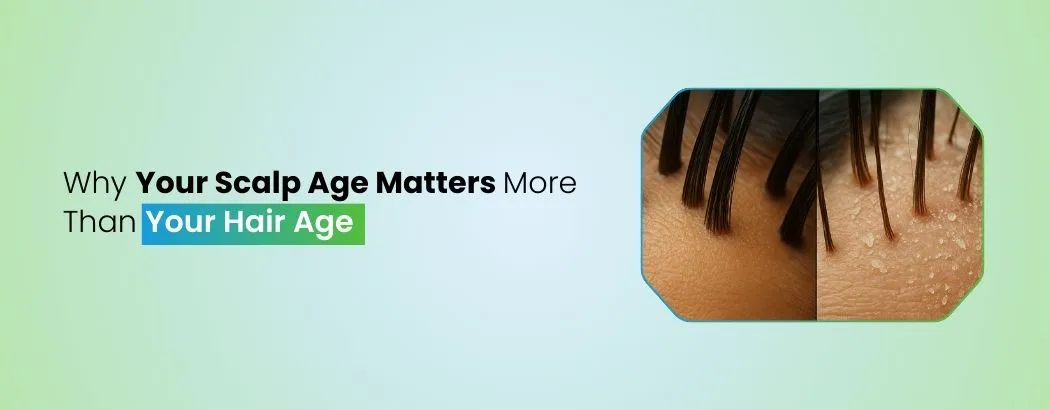
A younger scalp is full of oxygen, nutrients, hydration, and collagen. It supports strong follicles. An older scalp becomes thinner, drier, weaker, more sensitive, and more inflamed. Over time, this weak environment reduces the quality of new hair growth. Hair becomes thinner, weaker, and grows slower.
This happens silently. By the time you notice hair problems, the scalp has already been aging for years.
Why Do We Ignore Scalp Ageing?
Because we are trained to fix what we can see. Hair is visible, the scalp is not.
Also:
-
Hair products focus on shine and smoothness, not scalp biology.
-
Hair fall is marketed more than scalp health.
-
Most people do not understand that scalp is skin and needs skincare.
-
There is no routine “scalp checkup”, the way we have skin or dental checkups.
This lack of awareness leads to years of self-diagnosis and wrong treatments. People keep changing shampoos without treating the root cause: an aging scalp.
What Happens When Your Scalp Ages?
Scalp ageing is similar to facial skin ageing, but its effects are more serious because it directly impacts hair follicles.
Below are the changes that happen as scalp age increases.
1. Reduced Blood Circulation
The scalp becomes harder for nutrients to reach. Follicles receive less oxygen, leading to weaker hair strands.
2. Decreased Collagen and Elasticity
Collagen holds hair follicles in place. As collagen decreases, hair becomes loose in its root and falls easily.
3. Drier Scalp
Oil glands become less active. A dry scalp can lead to flaking, irritation, and brittle hair.
4. Smaller Hair Follicles
Follicles physically shrink with age. This is the beginning of thinning hair and male or female pattern hair loss.
5. Increased Inflammation
An aging scalp becomes more inflamed due to pollution, sun exposure, and stress. Chronic inflammation slowly damages the follicles.
6. Faster Hair Shedding
When scalp health goes down, the hair growth cycle becomes shorter. Hair spends less time growing and more time shedding.
7. Slower Hair Growth
The speed at which new hair grows reduces significantly.
8. Sensitivity and Itching
Aging scalp skin can feel itchy, irritated, or sensitive to products.
You might have noticed that each of these leads to hair fall. So the real problem is not always the hair. It is the scalp ageing underneath.
Signs Your Scalp Age Is Higher Than Your Real Age
Some early signs may look small, but they are actually strong signals of scalp ageing.
-
You get oily scalp in one day even after washing
-
You get dandruff or flakes often
-
Your roots feel weak or hair breaks easily
-
You see more hair in the drain after a shower
-
Your scalp feels tight or itchy
-
You feel pain when you tie or open your hair
-
Your hairline looks lighter or thinner
-
Your ponytail feels slimmer
-
Hair looks flat even with styling
-
You need more products to get volume
If you relate to three or more signs, your scalp age may be accelerating.
What Accelerates Scalp Ageing?
Understanding the triggers helps you protect the scalp on time.
1. Stress
Stress constricts blood flow and increases inflammation, making follicles weaker.
2. Pollution and Hard Water
Dust, chemicals, and hard water minerals create buildup that suffocates follicles.
3. Poor Nutrition
Low protein, iron, vitamin D, biotin, and omega levels harm scalp health.
4. Heat Styling
Repeated heat damages the scalp surface and speeds up ageing.
5. Wrong Hair Products
Harsh shampoos or heavy oils can irritate, inflame, or clog the scalp.
6. Hormonal Changes
Thyroid, PCOS, pregnancy, postpartum, and menopause can age the scalp rapidly.
7. Sun Exposure
UV rays break down collagen and dehydrate the scalp.
8. Tight Hairstyles
Constant pull weakens follicles and affects circulation.
9. Smoking
Reduces oxygen supply to the scalp drastically.
These factors combined can make a 25-year-old experience the scalp of a 40-year-old.
Scalp Age vs Hair Age: Why The Difference Matters
Hair age refers to how long the hair strand has survived after growing from the follicle. Scalp age refers to the environment in which that strand forms.
Here is how they differ.
Hair Age
-
Affects shine, texture, smoothness
-
Can be improved temporarily with products
-
Visible, so easier to treat
Scalp Age
-
Affects long-term growth
-
Controls thickness and density
-
Determines if hair fall will stop or continue
-
Invisible, so harder to notice
This is why experts focus on scalp treatments before hair treatments. Healthy hair cannot grow from an unhealthy scalp.
How To Check Your Scalp Age At Home
You can do a simple self-check.
-
Touch test
If your scalp feels dry, rough, or bumpy, it is aging faster. -
Pinch test
Gently pinch the scalp near your forehead. If the skin feels tight, it means collagen has reduced. -
Hairline check
Look in bright light. If tiny baby hair looks thin, shallow, or weak, it is an early sign. -
Volume test
Tie your hair into a ponytail. If it feels thinner than last year, your scalp is aging. -
Itch and dandruff pattern
Frequent irritation is a sign of inflammation, a major ageing marker.
These tests give you clues about the internal health of your scalp.
How To Slow Down Scalp Ageing
The good news is that scalp ageing can be slowed, controlled, and even reversed to an extent. The key is learning how to treat your scalp like skin.
1. Prioritise Scalp Care Over Hair Care
Invest in scalp serums, mild shampoos, exfoliators, and treatments instead of only hair masks and oils.
2. Weekly Scalp Exfoliation
Helps remove dead skin, product buildup, and minerals from hard water.
3. Use Products With Active Ingredients
Look for ingredients such as:
-
Salicylic acid
-
Niacinamide
-
Caffeine
-
Rosemary
-
Peptides
-
Hyaluronic acid
These improve blood flow, reduce inflammation, and give hydration.
4. Improve Nutrition
Include:
-
Protein
-
Iron
-
Zinc
-
Vitamin D
-
Omega 3
-
B complex
-
Antioxidants
Nutrition directly influences scalp age.
5. Reduce Heat Styling
Air dry whenever possible. If you must style, use a heat protectant.
6. Manage Stress
Yoga, meditation, sleep, and breathing exercises improve blood circulation.
7. Avoid Heavy Oils
Thick oils clog follicles, cause dandruff flare-ups, and trap dirt. Light oils or scalp serums work better.
8. Protect From Sun
Wear a scarf or use UV protection sprays if spending long time outdoors.
9. Choose Loose Hairstyles
Let the scalp breathe. Tight styles pull follicles and increase aging.
Professional Treatments That Help Reduce Scalp Age
When scalp ageing is moderate to advanced, professional treatments give faster and long-lasting results.
1. Scalp Analysis
A detailed scan helps understand follicle health, density, oiliness, hydration, and inflammation.
2. Medicated Scalp Peels
Help reset the scalp by removing buildup and dead skin.
3. PRP Therapy
Boosts collagen, improves circulation, and strengthens follicles.
4. GFC Therapy
Uses growth factors to improve scalp quality and accelerate regrowth.
5. Low-Level Laser Therapy
Improves oxygen flow and keeps follicles active.
6. Mesotherapy
Delivers vitamins and peptides directly to the scalp.
7. Hair Transplant (for severe scalp ageing)
When follicles are damaged beyond repair, transplant becomes the best option.
All these procedures work because they target the scalp, not just the hair.
Why Early Scalp Care Is More Important Than Early Hair Care
Hair damage is easy to fix with styling, smoothing, or keratin treatments. But scalp damage is silent. Once follicles shrink permanently, they cannot be revived without medical help.
This is why early scalp care gives the longest-lasting results. The younger your scalp stays, the longer your hair stays thick and dense.
Think of scalp care as:
-
Your anti-aging investment
-
Your long-term protection against hair loss
-
Your foundation for healthy regrowth
The earlier you begin, the better your hair will look in your 30s, 40s, and beyond.